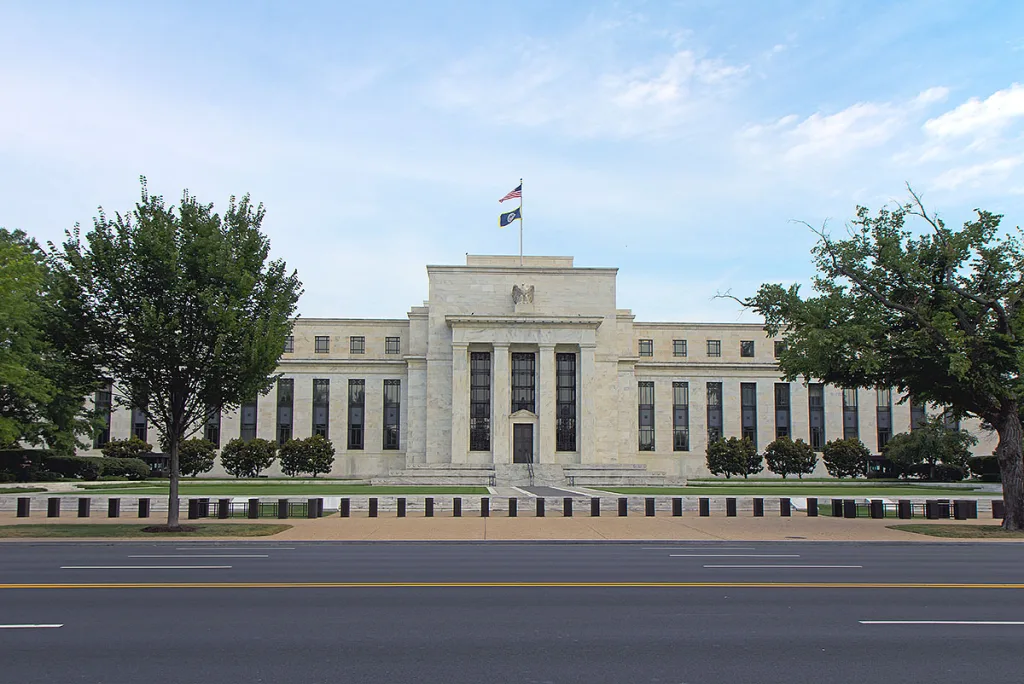
The trepidation preceding Kevin Warsh’s first Jackson Hole speech was of his own manufacture. Asked in July what he intended to say, the Chairman called the text a blank sheet of paper — read by markets, fresh from a presser judged muddled on both the inflation metric and the Fed’s principal tool, as evasion.
Three propositions carried Friday’s speech. First, the 2 per cent PCE objective is firm and fixed and short-term rates remain the predominant tool. Second, responsibility for sixty-five months of elevated inflation sits squarely with the central bank: no tariff alibi, no energy alibi. Third, and operative: with credit markets showing few signs of restraint and lending standards among the easiest on record, he would be hard pressed to call broad financial conditions restrictive. In July he had called them uneven; in August he withdrew that concession. Therefore 3.50–3.75 per cent is not, on his own diagnosis, leaning against inflation of 3.7 per cent.
Markets completed the syllogism. Implied odds of a 25 basis point increase on 16 September were roughly 35 per cent on Thursday; they sit near 58 per cent this morning. The two-year yield moved from 4.20 to 4.36 per cent, its highest in a month, while the ten-year rose five basis points and the thirty- year, at 5.21 per cent, barely moved — the flattening of a market expecting tightening to be delivered and to work.
Four forces explain the re-rating. First, Warsh refused to read the better-than-expected summer prints as improvement in underlying trends. Second, oil: US forces struck Iranian launchers on Larak Island on Sunday, frustrating a renewed attempt to mine Hormuz, Iran retaliated against American bases in Jordan, and Brent trades above $90. A central bank that has just claimed ownership of its inflation record cannot look through a supply shock in its sixth month.
Third, the dollar. The ECB moved to 2.25 per cent in June with September nearly fully priced, and the BoJ is at 1 per cent with four-in-five odds on 18 September. The mechanism is not peer pressure but the exchange rate: if Frankfurt and Tokyo tighten and Washington does not, Friday’s dollar gains reverse, and a softer dollar into $90 oil is imported inflation atop domestic inflation.
Fourth, and binding, the Committee. The proposition that a hold is itself discipline is spent. July split 9–3, with Hammack, Kashkari and Logan voting to hike — the most hawkish dissent since September 2016. Should September pass without a move and without data justifying inaction, that bloc grows; and a Chairman who has renounced forward guidance has no instrument for managing dissent in advance. The tail risk is not that Warsh hikes, but that he is outvoted, unseen since Eccles in 1939.
With the long end near 2007 levels and the Treasury’s buybacks having failed to hold the rally they bought, a hike would also compress the inflation risk premium there, purchasing lower thirty-year yields with higher two-year ones. Against all this stands the labour market: the economy shed 23,000 jobs in July, and housing and agriculture are straining, as Warsh conceded. August payrolls land on Friday and CPI the week after; a weak print would collapse the 58 per cent within an hour. The bar has shifted — September now requires a reason to abstain rather than a reason to move — but the outcome is not settled.
The harder question is what follows the first move, and Warsh has made it unanswerable. A central banker who renounces the management of expectations fights with one hand tied, because most of the job is anticipation rather than delivery: Draghi’s three words in 2012 were followed by an OMT programme that never bought a single bond. If payrolls hold and CPI does not surprise downward, the Fed hikes to 3.75–4.00 per cent. One thing is certain: if the FOMC skips September, the next option to hike becomes October, right before the mid-term election – Mission Impossible! Waiting until December also seems unrealistic.